Mitsubishi AC Short Cycling in Encino
First, the answer: If a Mitsubishi system short-cycles in Encino, call Encino Mitsubishi HVAC at (213) 805-8137 or book online: we trace it to oversizing, low refrigerant, a dirty coil, or a sensor fault across 91316 and 91436. An inverter unit that should modulate but keeps hard-stopping is tripping a protection, not running normally.
The short list
- Common causes: oversizing, low refrigerant, dirty filter/coil, thermistor faults.
- A dirty filter or coil trips P6 freeze protection and cuts cycles short.
- Low refrigerant shows P8 or U7 and forces protective stops.
- Inverter systems are designed to run long and slow; frequent hard stops signal a fault.
- Repairs range $0-$1,500 depending on whether it is a filter, charge, or sensor.
- Right-sizing a replacement, not upsizing, fixes oversize short cycling.
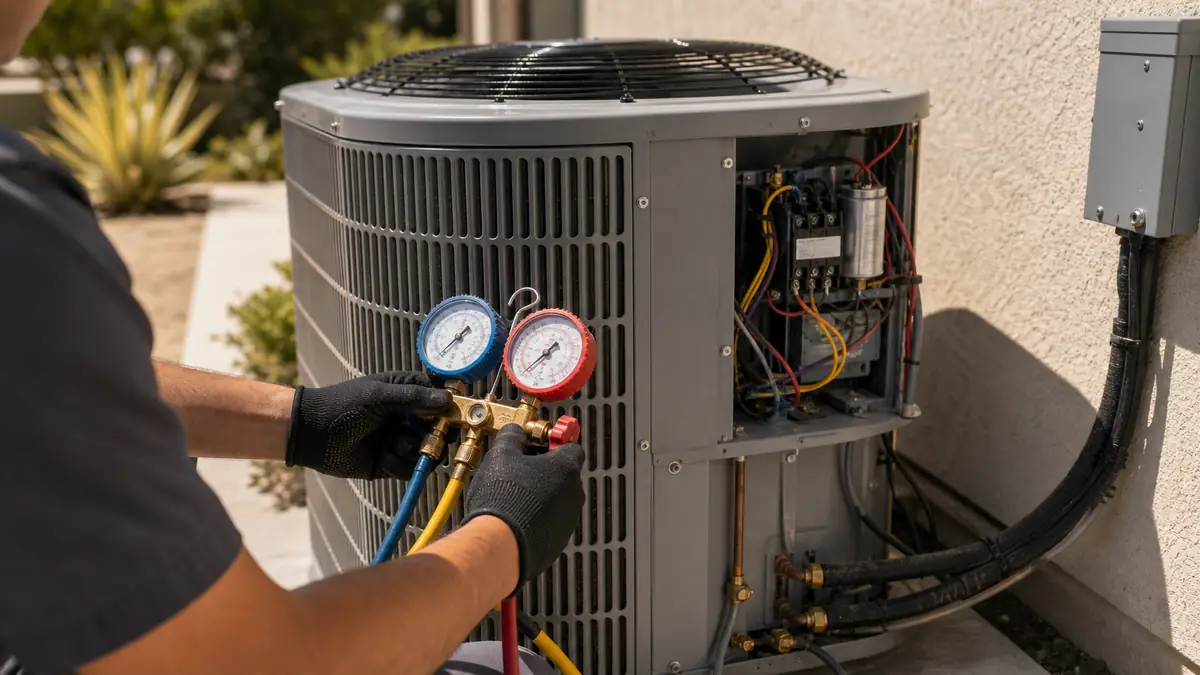
What causes a Mitsubishi system to short cycle?
An inverter Mitsubishi system is built to ramp down and hold a long, steady cycle, so when it instead starts and stops in quick bursts, something is forcing it off early. The usual roots are a system oversized for the space, low refrigerant from a leak, restricted airflow from a dirty filter or coil, or a faulty thermistor feeding bad temperature data to the board. Each leaves its own fingerprint, which the table sorts.
| Pattern | Likely cause / first check | Cost lane |
|---|---|---|
| Cools fast, stops, restarts minutes later | Oversized system or thermostat placement | Right-size at replacement |
| Coil frosts, cycle cuts short | Dirty filter or coil - P6 freeze protection | $0 - $250 |
| Stops with a refrigerant code | Low charge / leak - P8 / U7 | $225 - $1,500 |
| Erratic stops, comfort drifts | Room or pipe thermistor TH1/TH2 - P1 / P2 | $200 - $600 |
| Outdoor unit trips on protection | Inverter board or compressor - U5 / U6 | $400 - $3,500 |
Why is oversizing such a common cause in Encino?
For generations the local instinct was to oversize cooling equipment "to be safe," and Encino's large rooms tempted installers to bump the tonnage up. An oversized condenser drives a room cold, meets the thermostat within a few minutes, and quits before it dehumidifies or balances the temperature down a long ranch wing - then fires again soon after. The answer is not a bigger unit but a properly sized one, which is why we run a Manual J load calculation before recommending any replacement install.
How do refrigerant and airflow cause short cycling?
Low refrigerant and restricted airflow both push the system into protective stops. A leak drops the charge until the unit trips on low superheat (U7) or abnormal pipe temperature (P8); a clogged filter or coil starves airflow until the coil nears freezing and the board trips P6. Both shorten cycles and stress the compressor, but the fixes differ - a leak repair versus a cleaning and filter change - so we meter the charge and inspect airflow rather than assuming. The maintenance calendar heads off the airflow side.
How do you tell oversizing apart from a fault?
The two patterns look alike from the hallway but read differently on the gauges, and the distinction decides whether the fix is a repair or a redesign. A genuine fault leaves a fingerprint: a code on the controller, a low superheat reading, a frosted coil, or a thermistor that reports a temperature the room is not actually at. Oversizing leaves no code at all - the system simply satisfies the thermostat in three or four minutes, stops cleanly, and refires once the room drifts back, over and over. We time the cycles, read the charge and superheat, and check the thermistors; if every reading is healthy and the only complaint is rapid clean cycles in a room that never feels evenly cooled, the equipment is too large for the load. That is not something a part fixes. The cure is a right-sized replacement guided by a Manual J calculation, never a bigger condenser, and it is one reason we run the load math before any replacement install.
What does fixing short cycling cost in Encino?
The cost depends entirely on which root we confirm, so the diagnostic - about $129 to $200, often credited toward the repair - comes first. If the cause is a dirty filter or coil tripping P6, you are in the $0 to $250 range, often just a cleaning and a filter habit. A thermistor reporting bad data (P1 or P2) runs roughly $200 to $600. A refrigerant leak forcing protective stops on U7 or P8 lands at $225 to $1,500 depending on the leak location and recharge weight. An inverter board or compressor protection fault (U5 or U6) is the high end at $400 to over $3,500, where the warranty check matters most. Oversizing is the outlier: there is no repair line item, because the fix is a correctly sized new system rather than a part - which is why an honest load calculation up front saves the most money of all.
Short-cycling questions from Encino owners
What does short cycling mean on a Mitsubishi system?
Short cycling is when the system starts and stops in quick bursts instead of running a steady, longer cycle. On an inverter Mitsubishi unit that should modulate, frequent hard stops usually signal a protection trip - low refrigerant, a dirty coil restricting airflow, or a sensor fault - rather than normal operation.
Can an oversized system cause short cycling?
Yes, and we see it constantly in Encino. A condenser too large for the room chills it quickly, meets the thermostat, and cuts out before it can dehumidify or even out the temperature, only to fire back up minutes later. The fix is a right-sized replacement guided by a load calculation, never a bigger unit.
Is short cycling bad for the compressor?
It is. Every start is the hardest moment on a compressor, so repeated short cycles add wear and waste energy. On an inverter system that is engineered to run long and slow, frequent stops also point to a fault worth fixing before the compressor or board pays the price.
Could a clogged filter make my Mitsubishi short cycle?
Yes. A dust- and pollen-loaded filter or a dirty indoor coil restricts airflow, the coil approaches freezing, and the unit trips P6 freeze protection, cutting the cycle short. In Encino's dusty valley air this is one of the first things we check, and often the cheapest fix.
How do you find the real cause of short cycling?
We read the fault code, meter the refrigerant charge and superheat, inspect the filter and coil for airflow restriction, and test the thermistors. Short cycling is a symptom with several possible roots, so we confirm the cause by measurement rather than guessing at a part.
Related: AC not cooling, AC repair, AC installation, the maintenance calendar, and scheduling a visit.