Mitsubishi AC Repair in Encino
First, the answer: Encino Mitsubishi HVAC repairs Mitsubishi Electric mini-splits and condensers across Encino 91316 and 91436, from South of the Boulevard to Encino Hills, reading the P/E/U fault code and metering the part before any work. Most repairs land between $150 and $3,500, so call (213) 805-8137 or book online.
The short list
- Repairs M-Series MSZ/MUZ, MXZ and MXZ-SM multi-zone, and P-Series PUZ Mitsubishi systems.
- Capacitor and contactor jobs: roughly $150-$450 in 2026 SoCal pricing.
- Refrigerant leak repair and recharge: roughly $225-$1,500; flare joints are the common leak point.
- Inverter PCB or DC compressor work: $400-$3,500 depending on part and warranty status.
- Diagnostic $129-$200, often credited toward an approved repair.
- In-warranty Mitsubishi units referred to authorized service first.
What breaks most on Mitsubishi AC systems in Encino?
Encino's valley-floor heat against the Santa Monica Mountains - hot, still afternoons and 50-70 days a year over 90 F - is hard on outdoor electrical parts. The single most common failure we see is the run capacitor in a MUZ or MXZ condenser, followed by refrigerant leaks at flare connections, condensate-drain clogs on indoor MSZ heads, and inverter-board faults on systems that have ridden a decade of summers. The table below maps symptom to first check to a realistic cost lane.
| Symptom | Likely cause / first check | Cost lane |
|---|---|---|
| Outdoor unit hums, fan and compressor dead | Run capacitor; contactor if pitted - codes U2/U6 may appear | $150 - $450 |
| Warm air, frost on coil, weak cooling | Refrigerant leak at flare or sticking LEV/EEV - P8 / U7 | $225 - $1,500 |
| Water under the head, unit shuts off | Clogged condensate drain or failed drain pump - P4 / P5 | $129 - $450 |
| Head trips on freeze protection, weak airflow | Dirty filter or indoor coil restricting airflow - P6 | $129 - $350 |
| Comfort drifts, airflow ignores the room | Room or pipe thermistor TH1/TH2, or 3D i-see on MSZ-FS - P1 / P2 / P9 | $200 - $600 |
| One zone out on a multi-zone system | Branch box or shared S1/S2/S3 wiring - E6 to E9 | $200 - $800 |
| Whole system dead or tripping on startup | Inverter PCB or DC compressor - U5 / U6 / U8 | $400 - $3,500 |
How does a Mitsubishi AC repair actually go?
A repair is a sequence, not a parts swap. We work it in the same order every visit so the fix lands on the real fault:
- Read the equipment. Model and serial off the MUZ or MXZ data plate tell us the family, the refrigerant, and the warranty window. We pull the fault from the green operation LED blink pattern, the PAR wired controller, or the kumo cloud app.
- Confirm the code, then meter. A P8 or U7 sends us to pressures and superheat; a U6 sends us to the inverter and compressor windings; a P4/P5 sends us to the drain pan, float, and pump. We never condemn a board on the code alone.
- Name the part and quote. Microfarads on the capacitor, pull-in on the contactor, continuity on the thermistor, ohms on the fan motor - the meter reading, not a guess, sets the fixed price you approve before work starts.
- Make the repair. Capacitor and contactor swaps are bench-simple; a flare leak means recovering charge, reflaring or replacing the joint, pulling a deep vacuum, and weighing in the manufacturer charge; a board or compressor is a heavier sealed-system job.
- Verify before we leave. We re-run the system, recheck superheat and subcooling or the corrected charge, confirm the code is cleared, and watch a full cooling cycle so the complaint does not walk back in next week.
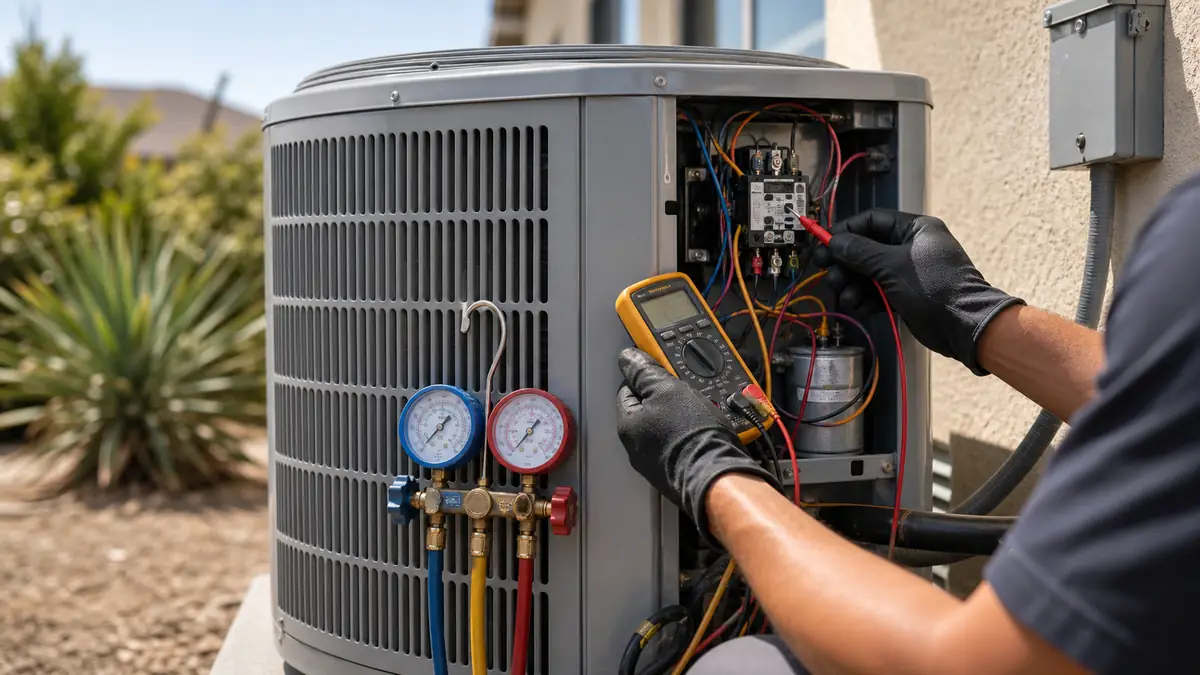
The instruments that ride every call: a digital multimeter, a microfarad-capable meter, a manifold or wireless probe set, a vacuum gauge, a leak detector, and the kumo cloud interface for reading and clearing M-Series faults.
Which Mitsubishi systems do you repair in Encino?
We service the full residential M-Series and the larger P-Series, and the line a home runs changes what fails and what the parts cost:
- M-Series single-zone (MSZ head + MUZ condenser). The MSZ-WR and MSZ-HM value and mid-tier heads, the MSZ-FS Deluxe with its 3D i-see occupancy sensor, and the high-efficiency MSZ-FX, each matched to a MUZ outdoor unit. Most drain, thermistor, and i-see faults live here.
- M-Series multi-zone (MXZ and MXZ-SM SMART MULTI). One outdoor unit driving two to eight heads through a branch box. A single-zone complaint here usually traces to the branch port or the shared S1/S2/S3 wiring, not the head showing the symptom.
- M-Series ducted and cassette (SVZ/MVZ, SEZ, MLZ). Air handlers and recessed cassettes for finished estate space. These carry ECM blower motors, which is where the $450-$2,300 motor band applies.
- P-Series (PUZ outdoor, PEAD/PVA air handlers). Higher-capacity ducted and ductless for large Encino estates. Note the newer single-zone ducted P-Series uses R-454B refrigerant rather than the R-410A in legacy M-Series, which changes the recharge.
How do you diagnose a Mitsubishi fault code?
Mitsubishi reports faults through the indoor unit's green operation LED blink pattern and as alphanumeric codes on the wired controller or the kumo cloud app. P-codes point at indoor sensors and protection (P4 drain, P6 freeze protection from low airflow), E-codes flag communication and remote-controller issues (E6 through E9 between indoor and outdoor units), and U-codes are outdoor, compressor, and inverter protection (U1 high pressure, U6 compressor overcurrent, U8 outdoor fan motor). We confirm the code, then verify the actual part with a meter rather than swapping boards on a guess.
A slow, steady green blink is usually normal standby or defrost. Rapid or patterned blinking, often paired with the red timer LED, is the unit flashing an error - that is when you read the controller or app for the exact code and call us.
What does a refrigerant leak repair involve?
On ductless Mitsubishi systems the flare connections at each indoor head are the usual leak point, especially if the original install over- or under-torqued them. We pressure-test, find the leak with electronic detection or nitrogen, reflare or replace the joint, pull a deep vacuum, and recharge to the manufacturer's weighed-in charge. Legacy M-Series runs R-410A at roughly $50-$80 per pound installed; newer single-zone ducted P-Series uses R-454B, which we account for in the quote. We never just "top off" a leaking system, because that wastes refrigerant and masks the real fault.
What does a Mitsubishi AC repair cost in Encino, and why?
Most Encino repairs sit between a $129 diagnostic and a $3,500 sealed-system job, and the spread comes down to which part failed and whether the unit is still in warranty. The cheap end is mostly labor and a trip charge over a $10-$45 part; the expensive end is a premium inverter component plus the recovery, vacuum, and recharge a sealed system demands. Here is how the common jobs break down:
- Capacitor or contactor: $150-$450. The part is inexpensive; SoCal trip and labor carry the cost. Often done together for modest added labor, and the single most common no-cool fix on a hot afternoon.
- Condensate drain or pump: $129-$450. A cleared P4/P5 clog can be a same-visit fix; a failed drain pump adds the part.
- Refrigerant leak repair and recharge: $225-$1,500. Leak search runs the low end; reflaring or replacing a joint, pulling vacuum, and weighing in R-410A at roughly $50-$80 per pound pushes the high end. A major coil leak sits at the top.
- Inverter PCB or control board: $400-$2,000. The Mitsubishi inverter board part alone often runs $120-$800-plus, which is why we meter before condemning one.
- DC inverter compressor: $1,200-$3,500. Far lower if the unit is in warranty and you pay labor only - one more reason to read the data plate first.
- Diagnostic: $129-$200, usually credited toward an approved repair.
Encino's heat is itself a cost driver: 50 to 70 days a year over 90 F bake the outdoor electrical parts, so a 12-year-old MUZ on a Royal Oaks lot fails its capacitor far sooner than the same unit would in a coastal microclimate. These are approximate 2026 SoCal ranges - we set the fixed price at the diagnostic, after the meter, not before.
When is repair the wrong call?
Where your system still sits inside the Mitsubishi parts-and-labor warranty, the repair belongs with a Mitsubishi Diamond or authorized dealer first so the claim holds - we say that plainly rather than billing you for covered work. Out of warranty, a failed inverter board ($400-$2,000) or DC compressor ($1,200-$3,500) on a unit past 12 years can run to half a fresh single-zone install. That is the moment we walk you through the buying-guide math and whatever LADWP or SCE rebate a high-SEER2 replacement might capture.
Encino AC repair questions
Why is my Mitsubishi wall head running but the room stays hot?
The most common cause in Encino is low refrigerant from a leaking flare joint, which often throws a P8 pipe-temperature code or U7 low-superheat. The head keeps blowing air but cannot remove heat. A dirty filter or a sticking LEV expansion valve produces the same complaint, so we meter pressures and superheat before adding any refrigerant.
How much is a capacitor replacement on a Mitsubishi condenser in Encino?
The capacitor part is cheap, but the SoCal trip and labor put the job in the $150-$450 range, often combined with a contactor for modest added labor. If your outdoor MUZ or MXZ unit hums but the fan and compressor stay dead on a hot afternoon, the capacitor is the first thing we meter.
Do you repair multi-zone Mitsubishi systems with several heads?
Yes. On MXZ and MXZ-SM systems a single fault often traces to the shared inter-unit S1/S2/S3 wiring or a branch box rather than the head showing the complaint. We test each zone back to the outdoor unit so we fix the actual cause, not just the symptom in one room.
Is it worth repairing an older Mitsubishi system or should I replace it?
Below roughly 10 years, repair takes it almost every time. Once a unit is past 12 years and a failed inverter board or DC compressor enters the picture, that repair can rise to nearly half of what a new single-zone system costs, so replacement starts to make sense - all the more when a rebate-eligible high-SEER2 unit is on the table.
Will you work on a Mitsubishi unit another company installed?
Yes. We repair Mitsubishi equipment regardless of who installed it across Encino. If we spot an install defect, like an unflared connection leaking refrigerant or an undersized line set, we will document it so you can decide how to handle it.
Related: heat pump repair, AC not cooling diagnostics, short cycling, wall-mount mini-splits, and the Encino services hub.