Mitsubishi U2 Code in Encino
First, the answer: A Mitsubishi U2 code in Encino, CA (ZIP 91316 or 91436) means the outdoor unit read high discharge temperature and shut down to protect the compressor - usually low refrigerant or a blocked outdoor coil. Stop resetting it and call Encino Mitsubishi HVAC at (213) 805-8137 or book online.
The short list
- U2 = high discharge temperature at the outdoor unit, read from the discharge thermistor.
- Top causes: low refrigerant, a dirty or blocked outdoor coil, a failing compressor.
- U-codes are outdoor and inverter protection; U2 specifically guards the compressor.
- Charge or coil-airflow fix: $225-$1,500. A failing compressor: $1,200-$3,500.
- A repeating U2 is urgent - each lockout stresses the compressor; stop resetting.
- Most U2 calls in 91316 and 91436 booked same-week; many same-day in a heat stretch.
What is a Mitsubishi U2 code telling you?
U2 is the compressor's last line of defense. The outdoor inverter board watches a discharge thermistor mounted on the hot-gas line leaving the compressor. Refrigerant leaving a healthy compressor is hot, but there is a hard ceiling - run past it and the oil breaks down and the windings cook. When that thermistor reads above the safe limit, the inverter cuts the compressor and posts U2 on the controller, the kumo cloud app, or the outdoor board's LEDs. So a U2 is not the failure; it is the system stopping itself before the failure. The discharge temperature climbs for a reason, and that reason is almost always one of three: there is not enough refrigerant carrying heat away, the outdoor coil cannot reject the heat it is carrying, or the compressor itself is struggling. Reading U2 narrows the search to the outdoor unit and the refrigerant circuit - the work is finding which of the three it is.
Why does U2 surface in Encino's climate and homes?
Discharge temperature is sensitive to outdoor heat and to charge, and Encino stacks both against the system. The valley sits south-central in the San Fernando Valley, walled off from the coastal breeze by the Santa Monica Mountains, so summer afternoons sit warm and still with 50 to 70 days a year over 90 F. High ambient already pushes head pressure and discharge temperature up; the system has less margin before the limit. Now add an Encino-specific airflow problem. On the hillside lots in Encino Hills off Mulholland and the tucked side yards of Royal Oaks estates, condensers sit close to fences, jacaranda, and bougainvillea, and the outdoor coil packs with leaf litter and clipping debris until it can no longer reject heat. A coil that cannot shed heat sends discharge temperature straight up. The third driver is a slow refrigerant leak - common at flare joints on the long line sets that serve sprawling single-story Amestoy Estates homes - which leaves too little refrigerant to carry heat away. Any one of these, amplified by a 95 F afternoon, trips U2.
How do you diagnose a U2 code, instrument by instrument?
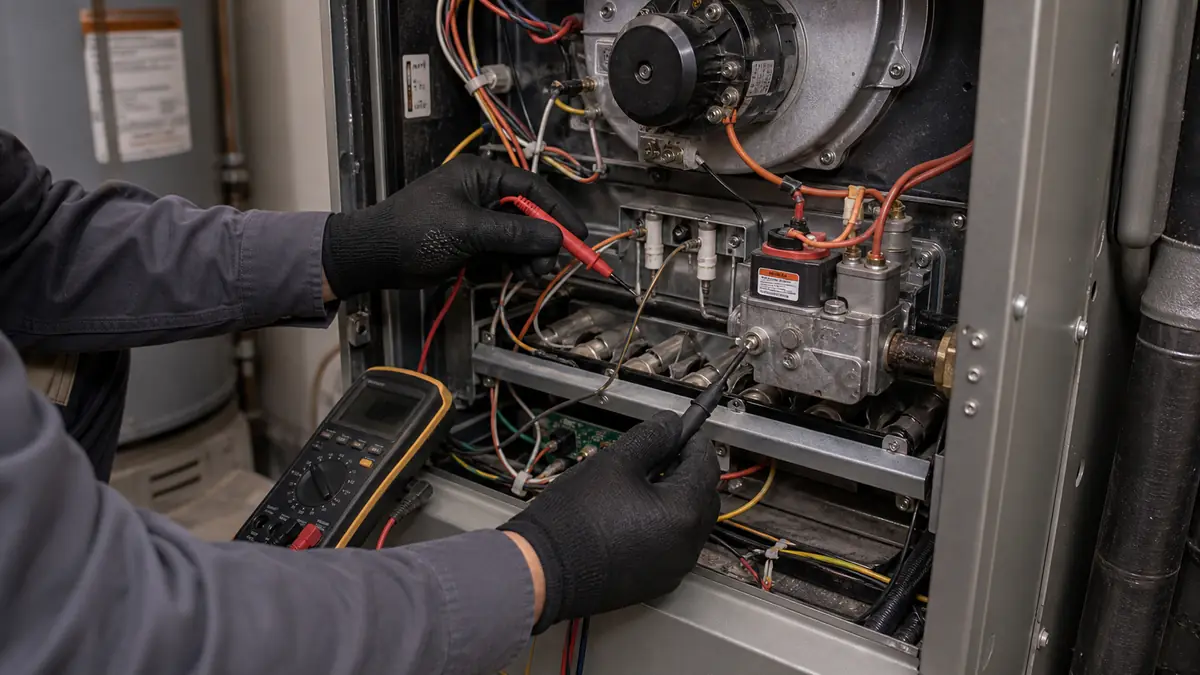
A U2 diagnosis works the outdoor unit and the refrigerant circuit, and because the compressor is at stake we confirm with readings before we run it hard. The sequence on a Mitsubishi condenser:
- Capture the conditions. Read the exact code and note the outdoor temperature and time - U2 that appears only at peak heat behaves differently than one that trips cold, and the kumo cloud timestamp helps.
- Inspect the outdoor coil. Look for leaf litter, debris, and bent fins choking the coil, and confirm clearance around the unit. A blocked coil is the fastest U2 cause to find and the cheapest to fix.
- Check the outdoor fan. Confirm the condenser fan reaches speed and moves air; a weak fan motor cripples heat rejection just like a dirty coil and drives discharge temperature up.
- Test the discharge thermistor. Measure its resistance against the temperature-resistance chart. A drifted sensor can false-trip U2, so we rule the sensor in or out before chasing charge.
- Gauge the refrigerant. Connect to the service ports and read suction and liquid pressures, then calculate superheat and subcooling against the model spec. Low charge with high superheat points at a leak we then locate, typically at a flare.
- Assess the compressor. If coil, fan, sensor, and charge are good but discharge still climbs, we check inverter output and compressor current draw against the IPM rating - a failing compressor or inverter board is the diagnosis of exclusion, confirmed by readings, never guessed.
What can a homeowner safely do, and what needs a pro?
Your safe lane is the outdoor unit's exterior. Cut power at the disconnect, then clear leaves, clippings, and debris from around and off the condenser, and trim back any shrubs or bougainvillea crowding the coil - give it at least a foot or two of clear space on all sides. Gently rinse the outside of the coil with a garden hose from the top down; do not use a pressure washer, which folds the fins. If the U2 was caused by a buried coil, that alone may clear it. Where to stop is firm: do not open the sealed refrigerant system, do not add refrigerant, and do not keep cycling power to a unit that re-trips U2. Unlike a routine filter code, a repeating high-discharge fault is actively risking the compressor every time it locks out and you restart it. Charge, leak repair, thermistor testing, and any compressor or inverter-board work all require a licensed tech with gauges and a recovery machine. The cheap fix is yours; the circuit is ours.
What does a U2 repair cost in Encino?
U2 spans the widest cost range of the codes we field, because its causes do. Clearing and cleaning a blocked outdoor coil sits at the low end, often within a $225 visit. Correcting a low charge - which means finding and repairing the leak, usually a flare joint, then vacuuming and weighing in fresh R-410A at roughly $50 to $80 per pound installed - runs up to about $1,500 depending on access and the leak's location on those long Amestoy Estates line sets. A failed condenser fan motor lands in the middle. The high end is the compressor itself or the inverter board: $1,200 to over $3,500, and on those we check the Mitsubishi parts warranty before quoting, because a covered compressor changes the decision between repair and replacement entirely. A diagnostic is $129 to $200, often credited toward an approved repair. If you are weighing a major repair against replacement on an older system, the buying guide lays out the math. The takeaway: a U2 caught early - while it is still a coil or a charge problem - is far cheaper than a U2 ignored until the compressor goes.
Mitsubishi U2 questions from Encino owners
What does a U2 code mean on a Mitsubishi?
U2 means the outdoor unit measured high discharge temperature and shut down to protect the compressor. The discharge thermistor reads the hot gas leaving the compressor; when it exceeds the safe limit, the inverter cuts the compressor. The usual causes are low refrigerant, a dirty or blocked outdoor coil, or a failing compressor. It is the system protecting its most expensive part.
Is a U2 code an emergency?
Treat a repeating U2 as urgent. Each high-discharge event stresses the compressor, the costliest component in the system, so a U2 that keeps tripping in a heat stretch earns a same-day call. A single U2 after the condenser was buried in leaves may clear once the coil is cleared. But do not keep resetting and running it - you are cooking the compressor every cycle it locks out.
Why does my Mitsubishi show U2 on hot Encino afternoons?
Because heat and low charge compound. On a 95 F still afternoon against the Santa Monica Mountains, head pressure and discharge temperature already run high; add a slightly low charge or an outdoor coil packed with bougainvillea and the discharge thermistor crosses the limit and trips U2. The fault often appears only at peak heat and clears by evening, which points at charge or condenser airflow.
How much does a U2 repair cost in Encino?
It depends on the cause. Correcting a low charge or clearing and cleaning a blocked outdoor coil falls in the $225 to $1,500 range, including finding and fixing any leak. If the compressor itself is failing, expect $1,200 to $3,500, and we always check the manufacturer warranty first because a covered compressor changes the math. A diagnostic is $129 to $200, often credited toward an approved repair.
Related: all Mitsubishi error codes, the P6 code, AC not cooling, AC repair, and scheduling a visit.