Mitsubishi P6 Code in Encino
First, the answer: A Mitsubishi P6 code in Encino, CA (ZIP 91316 or 91436) means the coil tripped freeze or overheat protection, almost always from low airflow - a dirty filter or coil - or low refrigerant. Replace the filter, let it thaw, then call Encino Mitsubishi HVAC at (213) 805-8137 or book online.
The short list
- P6 = coil freeze or overheat protection, read from the pipe (TH2/TH5) thermistor.
- Top cause: low airflow - loaded filter or fouled indoor coil; second: low refrigerant.
- Safe homeowner step: new filter, let a frosted coil thaw fan-only, one reset.
- Filter or coil clean: within a $79-$200 visit. Refrigerant or coil leak: $225-$1,500.
- Repeated freeze trips on low charge can slug liquid to the compressor - stop resetting.
- Most P6 calls in 91316 and 91436 booked same-week; many same-day in a heat stretch.
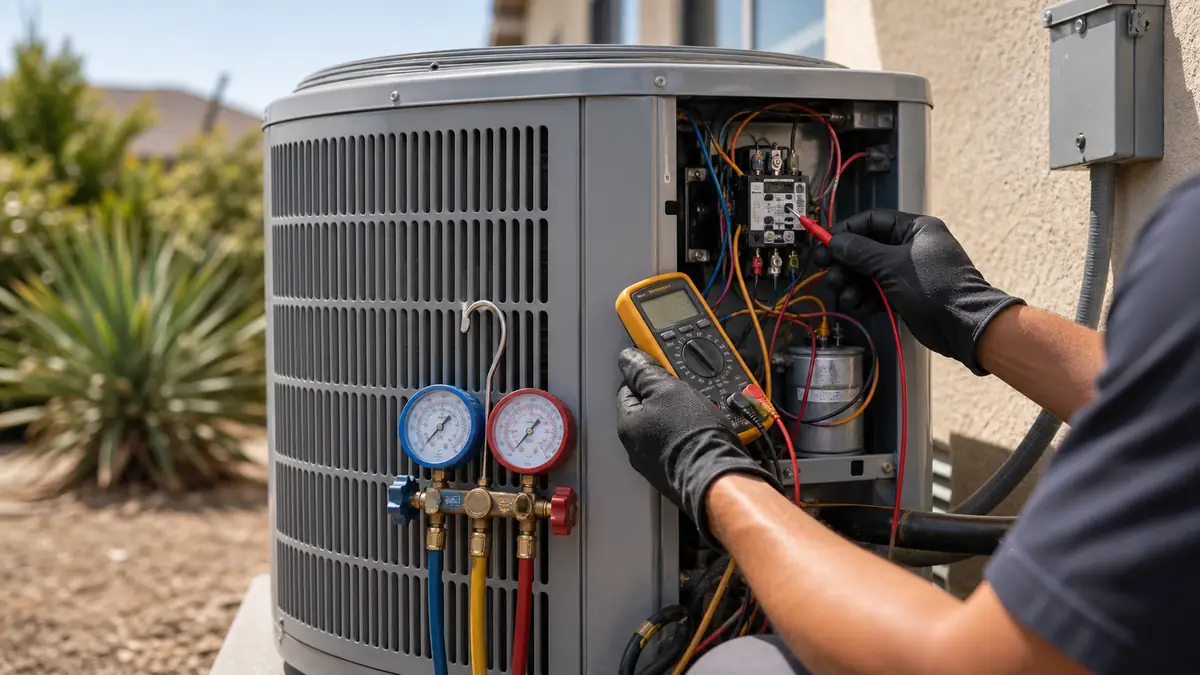
What does the P6 code mean on a Mitsubishi?
P6 is a protection trip, not a hardware failure in itself. The indoor control continuously watches the pipe thermistor - TH2 and TH5 on most Mitsubishi heads - which reads the refrigerant-line temperature at the coil. In cooling, if that line drops below the freeze threshold, the control fears the coil is icing and cuts the compressor to keep liquid refrigerant from flooding back; in some operating states it trips the same code for an overheat condition. Either way you get P6 on the green LED, the MHK2 or PAR remote, or the kumo cloud app, the head keeps blowing air, and the room stops cooling. The code is the symptom of a system that cannot move heat across the coil fast enough. The job is to find why - and in Encino that answer is usually upstream of the coil, in the airflow path, not in the thermistor itself.
Why does a Mitsubishi throw P6 in Encino homes?
The coil freezes because it is starved - either of air across it or of the right refrigerant charge through it - and Encino's conditions feed both failure modes. Valley air carries fine dust and a long pollen season, and a filter left in past 60 to 90 days chokes the return; we pull plenty of pleated filters here that look like gray felt. Behind a neglected filter the indoor coil itself fouls, and a dirty coil insulates exactly the surface that needs to exchange heat. The estate-scale single-story homes in Royal Oaks and Amestoy Estates often run long or partially collapsed flex runs and undersized returns, so even a clean filter cannot feed the coil enough air. Add Encino's heat load - 50 to 70 days over 90 F trapped against the Santa Monica Mountains - and a system already low on charge from a weeping flare joint will frost and trip P6 by mid-afternoon, then clear overnight, which is the classic intermittent pattern owners describe. On multi-zone ductless in newer rebuilds South of the Boulevard, one closed-off head can also unbalance airflow enough to freeze a single zone.
How do you diagnose a P6 code step by step?
A P6 diagnosis follows the air first, then the refrigerant, so the same readings rule airflow in or out before anyone touches a gauge set. Here is the sequence we run on a Mitsubishi system in Encino:
- Confirm the trip and thaw. Read the exact code and note whether the coil is visibly iced. We switch to fan-only and let it thaw completely - metering a frozen coil gives false numbers.
- Inspect airflow. Pull the filter and look at the indoor coil. A loaded filter or fouled coil is the most common P6 cause; we measure static pressure across the coil to confirm restriction rather than assume it.
- Verify the blower. Confirm the indoor fan reaches commanded speed and the wheel is not packed with dust, which quietly cuts airflow even with a clean filter.
- Test the thermistor. We check the TH2/TH5 pipe thermistor resistance against the temperature-resistance chart, because a drifted sensor can trip P6 on a perfectly healthy coil - uncommon, but we rule it out before condemning the charge.
- Meter superheat and subcooling. With the coil thawed and airflow confirmed, we gauge suction and liquid pressures and calculate superheat. Low charge reads as high superheat and a cold, frosting coil - that points at a leak, usually a flare.
- Find and fix, then verify. A cleaning restores airflow; a leak gets located, repaired, vacuumed, and weighed back in. We re-run the system, confirm a normal coil temperature split, and watch that P6 does not return before we call it done.
What can I safely check before calling a pro?
Two checks are safe and worth doing. First, replace the filter with the correct size and let any visible ice on the coil thaw completely with the system in fan-only - never chip ice off. Second, make sure return and supply grilles are not blocked by furniture or rugs, and that every indoor head on a multi-zone system is open, not closed off. After the coil is fully thawed, one reset is reasonable; if P6 stays gone, the filter or a blocked grille was the cause and you saved a visit. Where to stop: do not open the refrigerant circuit, do not add refrigerant, and do not keep resetting a system that re-trips within a cycle or two. Repeated freeze trips on a low charge can send liquid refrigerant back to the compressor and turn a $300 repair into a compressor. That is the line between a homeowner check and a pro call.
What does a P6 repair cost in Encino, and when is it urgent?
The price tracks the cause. A filter swap or a coil cleaning to restore airflow falls within a $79 to $200 visit, and that resolves the majority of P6 calls we see across 91316 and 91436. A drifted pipe thermistor is a minor part. If the freeze traces to low refrigerant, finding the leak, repairing the flare, pulling a vacuum, and recharging by weight runs $225 to $1,500, depending on access and how much R-410A weighs back in at roughly $50 to $80 per pound installed. A diagnostic is $129 to $200 and is often credited toward an approved repair. On urgency: a P6 that clears after a filter change is routine and can wait. A P6 that keeps returning while the charge is low should not keep running - every freeze-thaw cycle risks the compressor - so we treat a repeating P6 in a heat stretch as a same-day call. If you also smell something hot or see water spreading from the head, shut it off and call (213) 805-8137 now.
Mitsubishi P6 questions from Encino owners
What does a P6 code mean on a Mitsubishi?
P6 means the coil hit the freeze or overheat protection limit and the system shut the compressor to protect itself. The control watches the pipe thermistor; when the coil drops below freezing or climbs too hot, it trips P6. The usual cause is low airflow from a dirty filter or coil, sometimes low refrigerant. It is a protection trip, not a dead system.
Can I clear a P6 code myself?
You can try one safe reset after replacing a dirty filter and letting a frosted coil fully thaw with the fan running. If P6 clears and stays gone, the filter was the cause. If it returns within a cycle or two, stop resetting - repeated freeze trips with low refrigerant can slug liquid back to the compressor, and that needs a meter and a tech, not another restart.
Why does my Mitsubishi keep freezing in Encino?
A coil freezes when it cannot absorb enough heat from the airstream, so airflow or charge is the culprit. In Encino that is usually a filter loaded with valley dust and pollen, a coil fouled after a long cooling season, or a slow refrigerant leak at a flare. The freeze trips P6. We meter superheat to tell a charge problem from an airflow problem instead of guessing.
Is a P6 code expensive to fix?
Usually not. The most common fix - a fresh filter or a coil cleaning to restore airflow - runs within a $79 to $200 visit. If the freeze trip traces to low refrigerant from a leak, expect $225 to $1,500 to find the leak, repair the flare, vacuum, and recharge by weight. A diagnostic is $129 to $200 and is often credited toward an approved repair.
Related: all Mitsubishi error codes, the U2 code, AC not cooling, AC repair, and scheduling a visit.